

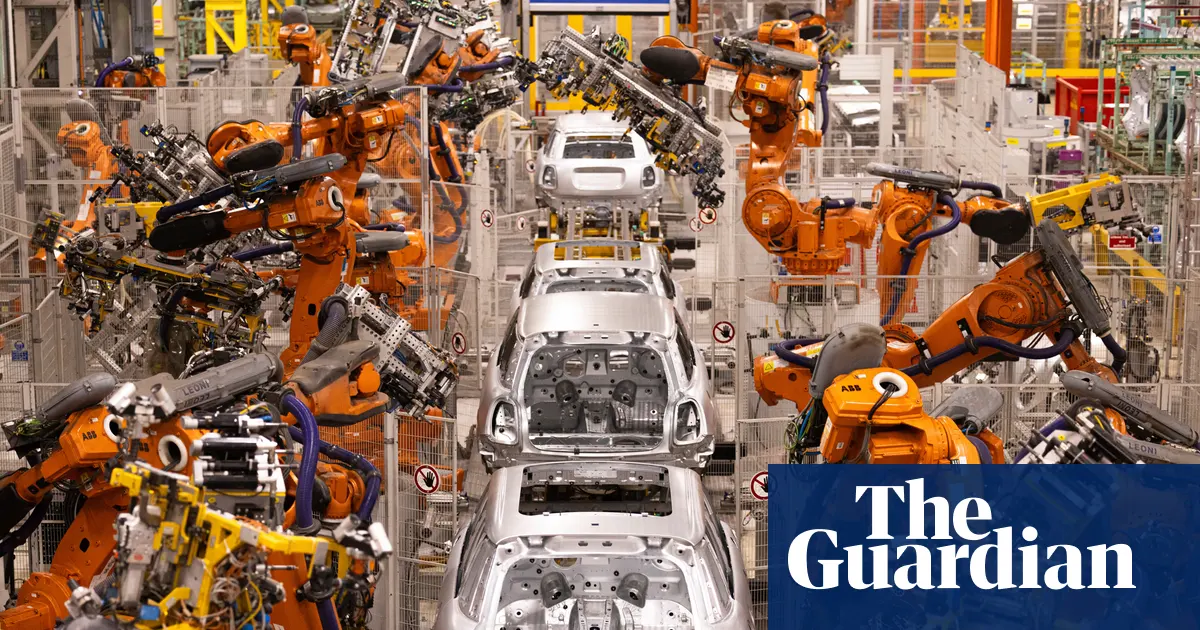
Carmakers are delaying final decisions to invest in UK factories until electric car sales rules are relaxed, according to the head of the British car industry’s lobby group.
The chief executive of the Society of Motor Manufacturers and Traders (SMMT), Mike Hawes, said those with existing UK operations were considering building new models, but had held back so far.
The British car industry has put heavy pressure on the Labour government to weaken the rules, known as the zero emission vehicle mandate, which forces manufacturers to sell an increasing share of electric cars each year up to 2030.
Jonathan Reynolds, who has returned to the role of business secretary under Andy Burnham, has indicated that the government is likely to water the mandate down.
“They’re waiting for the mandate, certainly,” Hawes said when asked about manufacturers’ plans. “There’s investment decisions on next model, next generation, which need a resolution, need an easing of the mandate.”
Calls for the rules to be eased have come as the British car industry struggles with competition from China, US tariffs and the extra costs of investment in electric technology. UK vehicle production fell 7.5% in the first half of 2026 compared with a year earlier, with factories producing 386,000 cars and commercial vehicles, according to the SMMT’s latest figures, published on Thursday.
The electric car charging industry has strongly opposed any further changes, while environmental campaigners are aghast that the government would consider a policy that would result in millions of tonnes of extra carbon emissions.
Hawes declined to name companies waiting for the government to relax the rules, but they may include Toyota, which has manufactured the Corolla in Derbyshire since 2019, and Mini, which has postponed plans to build electric models at its Oxford plant.
Nissan is in talks to build a car at its Sunderland plant for the Chinese manufacturer Chery, but no final decision has been made, and Jaguar Land Rover is preparing a series of new models.
There are other factors that could affect carmakers’ investment decisions, including Britain’s trading relationship with the EU. If the UK is unable to reach an agreement with Brussels, British carmakers could face tariffs from their biggest export market if they do not source batteries from within Europe under the so-called rules of origin.
The EU is separately also considering “made in Europe” rules that limit various subsidies to cars made in the bloc. The European car industry has called for the UK and other nearby countries such as Morocco and Turkey to be included in the subsidies.
Hawes said the EU trading relationship was seen as a priority for Reynolds, according to a conversation soon after he took office last week. Reynolds was “always a firm supporter of this sector”, he said.
Reynolds acknowledged in an interview on Wednesday with the Financial Times that a dilution of the mandate was likely to try to retain carmakers in the UK.