

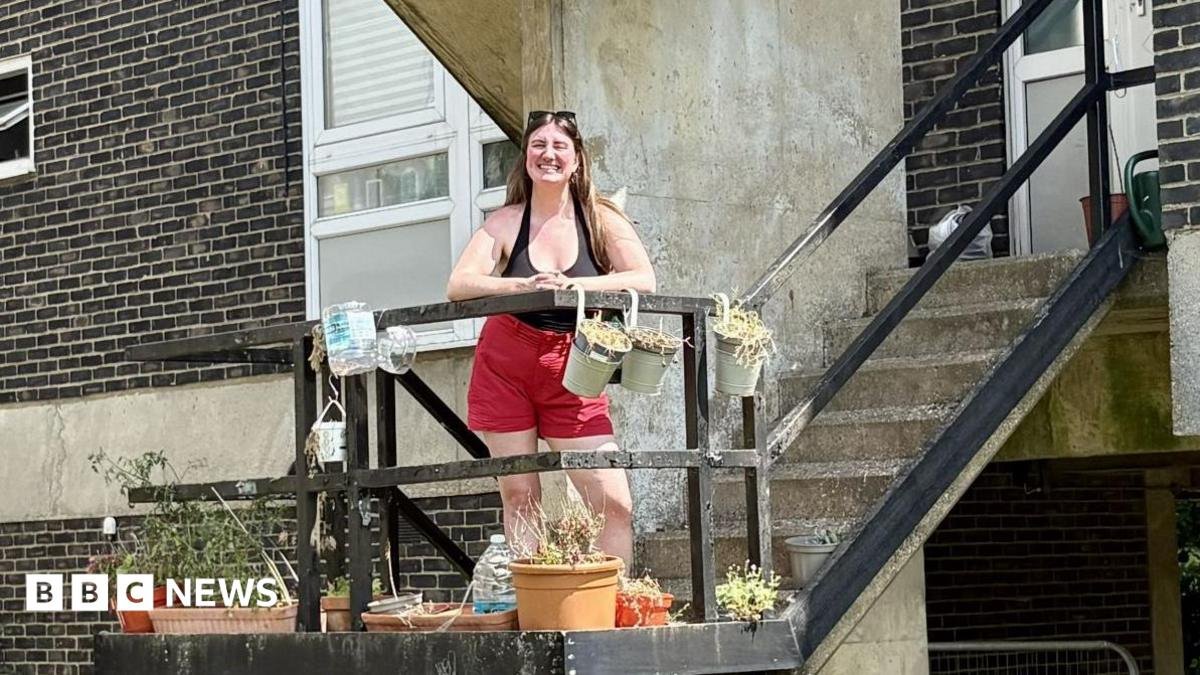
Would you live in a disused care home, pub or bank in exchange for a heavily discounted rent?
As cost of living pressures persist, a growing number of people are applying to become so-called property guardians – living in vacant residential or commercial buildings to protect them from squatters, vandalism and disrepair.
They typically pay 30-50% less rent than private tenants, sometimes with bills thrown in, In exchange for looking after the buildings.
However property guardians also have significantly fewer rights than private renters and can be evicted with just 28 days’ notice.
Katrina, 29, has spent the last 10 months living with around 50 other people in an Edwardian mansion in Hampstead, London, which was used as a care home until 2015.
The postgraduate student, who says she could not afford to rent privately in the capital, currently pays £580 a month for her room including bills and council tax, about £400 below the London average, external.
Katrina says guardianship gives her the chance to live in an unusual property and describes the mansion as an “incredible” and “romantic” place despite it being “quite run down”.
Set in 1.7 acres of gardens, the building has grand staircases, south-west-facing balconies and chandeliers in some rooms, but it does have some downsides: “We’ve had mushrooms growing on the walls, leaks, parts of the balcony stonework have fallen off,” says Katrina.
Katrina says she loves the communal aspect of guardianship, which is “somewhere between living in university halls, a block of flats and a fancy squat”.
She lives with “all sorts of people”, from lawyers to artists, sharing bathrooms, a kitchen and communal living areas, and regularly socialising.
But there are disagreements over things like noise, she says. And while Lowe, the company that manages the property, operates a stringent vetting process for its guardians, two residents have been asked to leave because of antisocial behaviour – one for alleged sexual harassment.
Lowe tells the BBC it acts “quickly and decisively” on the rare occasion someone breaches its standards and that the “overwhelming majority” of guardians go on to be “brilliant, community-minded residents”.
In general, guardians have fewer rights than private renters, external because they hold a “licence to occupy” rather than a tenancy.
Guardianship companies are not obliged to protect their deposits or carry out repairs not specifically provided for in the agreement. Landlords can also visit at any time, without warning, and evict residents without giving a reason.
Katrina admits she worries about the temporary nature of her arrangement sometimes. A developer bought the former care home last year and plans to turn it into flats, so she will eventually have to leave.
“It’s really precarious in that sense. It’s not guaranteed to last. If anyone doesn’t like that, it’s not for them,” she says.
Last year, the Property Guardian Providers Association (PGPA) estimated there were between 10,000 and 15,000 property guardians in the UK, mainly in major cities, with most aged between 20 and 35.
The trade group says the number of people applying has risen sharply as rental costs soar.
David Hale, 32, became a guardian almost 10 years ago to save money and has never lived in standard rental accommodation.
He and his wife now rent a “massive” space at a former primary school in Brixton, South London, for around £1,500 a month, including bills and council tax. He says they wouldn’t be able to afford a similar property otherwise and save about £1,000 a month.
Prepare to be flexible: You may stay for several years, or you may need to move on with relatively short notice.
Choose an established guardian company: Look for a reputable provider with good health and safety procedures
Read your licence agreement carefully: Understand your responsibilities to the building, house rules and visitor policies
Know your rights: Guardians are legally entitled to a court order before they can be evicted and their home must be safe to live in
Embrace community living: Be considerate of those you live with and respect shared areas.
Sources: the Property Guardian Providers Association, Shelter, Ad Hoc Property Management
Around 20 guardians live in the school’s open classrooms and offices, sharing a kitchen and large garden.
But while David has enjoyed communal living, he and his wife are saving to buy their own home: “We wouldn’t want to share toilets and bathrooms forever. We also want to start a family.”
The PGPA believes guardianship could help ease the UK’s housing crisis by providing affordable temporary accommodation for thousands of people.
It points out that over a million homes currently stand empty, along with tens of millions of square feet, external of non-residential property.
But housing charity Shelter argues the rise of property guardianship shows how people are being forced “further and further afield just to keep a roof over their heads”.
“For most, this isn’t a good alternative to an affordable, stable home,” says chief executive Sarah Elliott.