

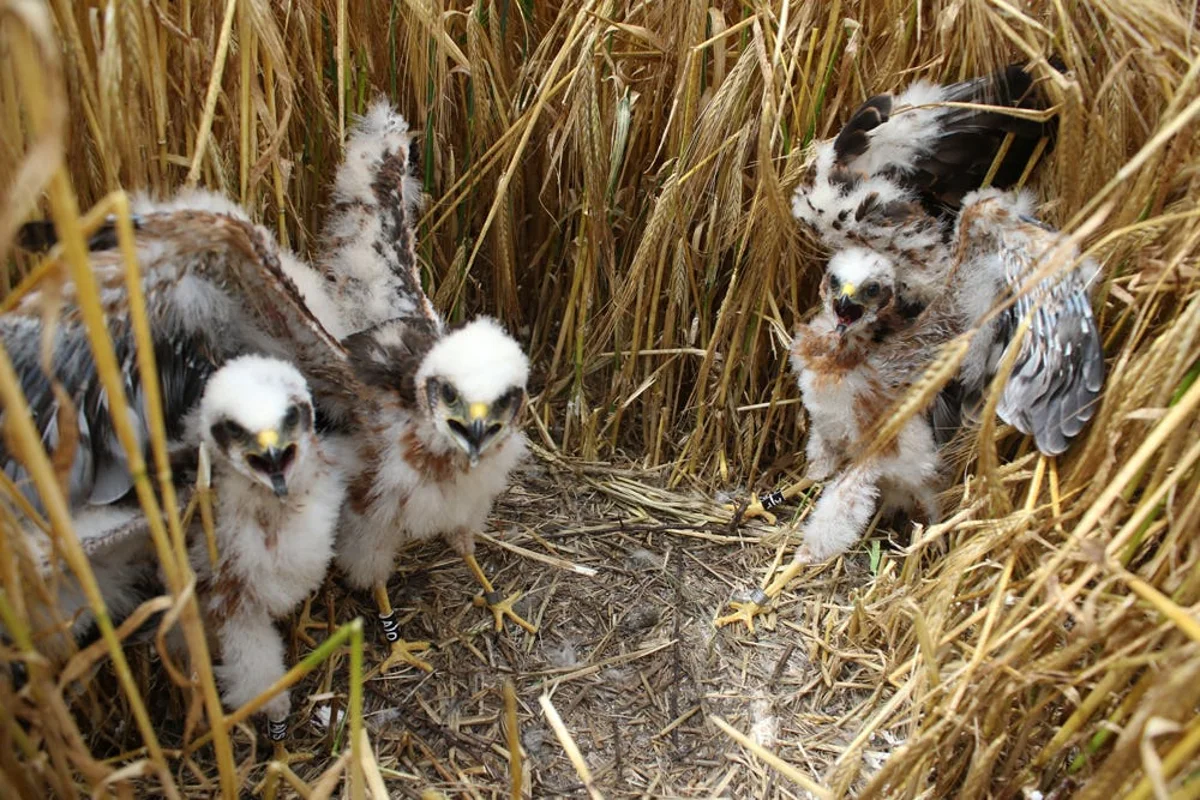
The species was placed on the ‘red list’ of birds most at risk in 2021
The UK’s rarest breeding bird has successfully raised six chicks after returning to nest at a secret location for a second year running, according to conservationists.
Last year, a pair of Montagu’s harriers nested at the same undisclosed spot on farmland in England, rearing four chicks in the bird of prey’s first successful breeding attempt since 2019.
This year, the male — who was ringed as a chick in a protected Wiltshire nest in 2016 and is known as “AU” — managed to breed with two new females across two nests a short distance apart.
He successfully helped to feed and rear three chicks in each of the nests, the RSPB said.
Mark Thomas, Montagu’s harrier species lead at the RSPB, said: “AU is truly awesome, he is single-handedly propping up this species in the UK with his amazing display flights in May being rewarded by attracting two new breeding females, seemingly out of thin air.”
Montagu’s harriers winter in Africa and return to Europe to nest, often setting up home in agricultural fields – particularly winter sown cereals in the UK.
They have never been common as a nesting bird in the UK, but numbers have declined from a high of nine successful nests in 2011, with no successful breeding between 2020 and 2024.
The species was placed on the “red list” of birds most at risk in 2021, the RSPB said.
The charity said careful monitoring, in partnership with the farmers on whose land the birds nested, meant the nests were protected by fences to exclude ground predators such as foxes.
The chicks were all ringed in mid-July, and in a UK-first, two of the juvenile females were fitted with £3,000 state-of-the-art lightweight satellite tags which will allow conservationists to follow the birds daily on their 7,000-mile trip back to West Africa.
Mr Thomas said: “We are doing our absolute utmost to save this iconic species in the UK and are delighted with six flying juveniles this year.
“The satellite-tagging of juveniles for the first ever time should give us a direct insight into their migration, survival and when and where they return to the UK.
“This has been a true team effort and we would like to thank the farmers, conservationists and our sponsors Mark and Mo Constantine.”
Conservationists are also urging birders to look out for the other youngsters, which are not fitted with satellite tags, as they leave the country and report sightings by emailing the RSPB’s Montagu’s hotline at montys@rspb.org.uk.
Join thought-provoking conversations, follow other Independent readers and see their replies