

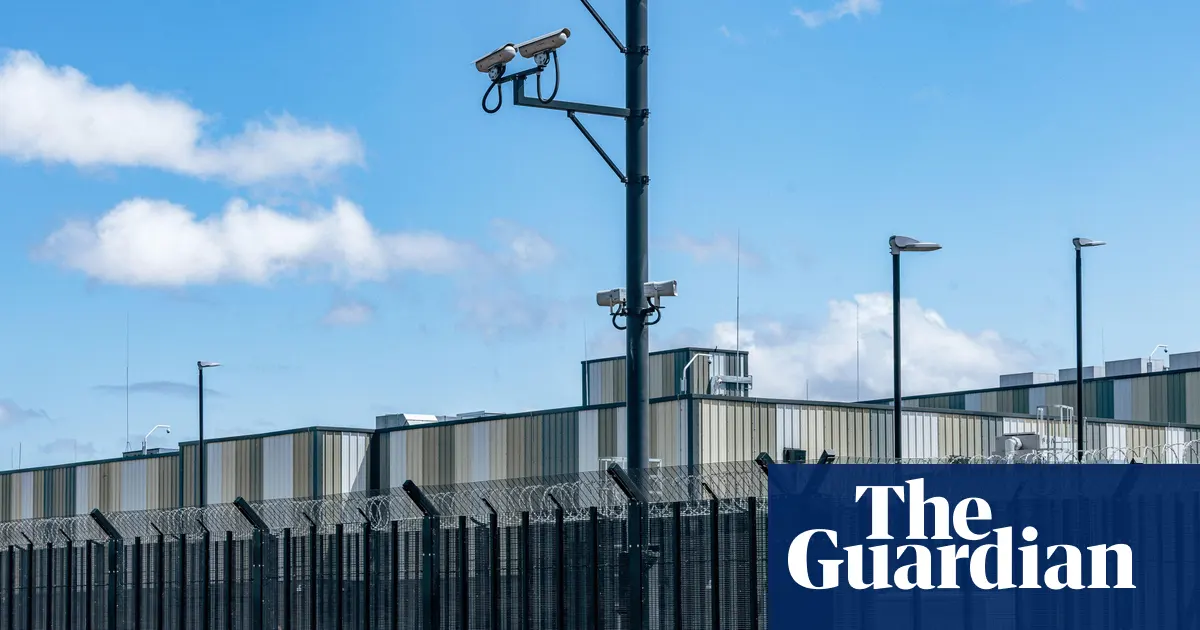
Good morning. This summer, datacentres have become targets of resistance across the world. Ever since the arrival of ChatGPT, big tech has been lobbying for the creation of enormous new facilities. Many governments claim they’re essential in any country that wants to cash in on AI.
UK politics | Andy Burnham has blamed Brexit and Margaret Thatcher for a decade of low growth in the UK, arguing that Britain needs to be brutally honest about having taken “a series of wrong turns” in the last 40 years.
Nepal-Tibet | A week on from the flash flooding disaster, authorities are urging relatives of the thousands of missing and dead to provide blood samples.
Middle East | The US has launched new airstrikes on Iranian targets, prompting counter strikes by Tehran targeting American interests in Bahrain, Kuwait, Jordan and Iraq, fuelling concerns about a wider renewal of hostilities.
Ukraine | Russia has opened a deadly new phase in its war against Ukraine by deliberately targeting the country’s railway network, with six employees killed on Tuesday in the latest strikes on Kyiv.
US news | Mark Carney has rebuked Donald Trump’s administration and urged officials in Washington to “start being serious” amid escalation trade tensions between the US and Canada.
In August I attended a meeting of campaigners and councillors in the east London borough of Tower Hamlets, where the government has recently approved plans for a 5,200 sq mile datacentre on the site of an old brewery off Brick Lane. The meeting, held on a sunny Monday evening, went on for three hours, in a stifling hall so packed that organisers had to create an overflow room. It’s a testament to how divisive the subject has become.
The new east London datacentre won’t be anywhere near as large as the “hyperscale” datacentres that power AI, which are typically 10,000 square feet or more. Neither is it the first to be built in the area (there are already three similarly sized developments nearby). But attenders I spoke with shared the same concerns as other campaign groups globally. They worried about the amount of energy the building will consume (5.2MW, according to a local campaign group, which is enough to power 15,000 homes), about its use of water (projections for this haven’t been released), and about the noise and heat it could emit.
They have good reasons to be concerned. The IMF estimates that by 2030, datacentres will consume more energy than all but the world’s three largest state emitters (China, India and the United States). They are already driving up electricity prices: one analysis found that wholesale electricity prices rose 267% over five years in locations near datacentres in Virginia. And although the industry argues that technology in newer AI datacentres consume less water than older facilities, not even the Environment Agency knows how much water datacentres use. It’s one of many unknowns.
Much of the anger here centres on how it’s been approved. Despite fierce opposition from local residents and Tower Hamlets council, which wants the site to be used for hundreds of homes, housing secretary Angela Rayner intervened, overruling the council to approve the application, citing its creation of 44 homes (only six of which will be socially rented) as a “significant” public benefit.
“When you have Andy Burnham talking about devolution and democracy, this feels like a slap in the face,” Henna Khanom, a Tower Hamlets resident, told me. “To me, it feels like many of these are springing up in places where low-income, ethnic minority communities just don’t have the power to resist these changes.”
This reflects a feature common to many of these battles: locals feel that datacentres are being forced on them against their will, with very little transparency or democratic oversight.
Globally, the number of “hyperscale” datacentres has nearly tripled since 2018. The UK had 52 datacentres in 2000, and today there are an estimated 520, roughly 48 of which are “hyperscale”, though it’s impossible to get exact figures, since nobody (not even the government) knows the total number that have been built. In the US, where local governments have signed NDAs with tech companies, information is shielded from scrutiny. In the EU, Microsoft and other American tech companies successfully lobbied to conceal the environmental impact of their developments.
Secrecy is power, particularly when your industry devours massive amounts of energy, much of it powered by fossil fuels. Because developers can wait years for an electricity grid connection, many are now opting to build their own gas-fired power plants instead. In the UK, more than 100 datacentres intend to burn gas to generate their electricity. It’s possible that some may do this permanently. These are reasons you might expect more scrutiny of these developments, not less.
“We’re in an extremely anti-democratic moment with AI,” the Guardian’s tech correspondent Aisha Down tells me. It’s no wonder, then, that so many protests are kicking off. Several weeks ago, police in Scotland warned one developer that public anger over these buildings was so great it now poses a security risk.
Why does the government want more of them?
The Starmer government tended to proselytise about the benefits of big tech. In documents outlining the UK’s AI strategy last year, it argued that datacentres were “the engines of the AI age”, and set out its plans to accelerate construction. So far, Burnham’s government seems to agree: last week, he rejected the Green party’s proposal for a moratorium on new developments, arguing this would “send investment and good jobs abroad”.
Since the start of this year, the government has allowed datacentres to opt into Nationally Significant Infrastructure Projects (NSIPS), where the secretary of state rather than local councils make planning decisions, enabling developers to bypass local scrutiny. Two of the first datacentres to opt into the NSIPs scheme are applying to build new private gas power stations to fire up their operations, which will together be responsible for more than 4.5m tonnes of carbon emissions. “Most people don’t want diesel generators running constantly near where they live,” Aisha says. “That sort of thing is upsetting to communities.”
There has been lots of noise among policymakers about the UK being an “AI maker, not an AI taker” that can’t afford to be left behind in the AI “race” or lose its AI “sovereignty.” But nobody seems to agree on exactly how datacentres achieves these vague aims. Will they rejuvenate post-industrial areas with shiny new jobs? Probably not. Will they help the UK “shape the AI revolution”? It’s hard to see precisely how, when US tech companies building many of the datacentres on UK soil retain control over infrastructure, IP and profits. “People in the highest echelons of power seem to be making policy based on AI Fomo and vibes,” Aisha says.
Having written about the True Love Waits Christian purity campaign in the 90s, I wasn’t overjoyed to see its latest iteration in Girls Gone Bible. Alaina Demopoulos explains why it makes sense for so many Gen Z women. Libby
I spent a childhood summer in France convinced I could communicate (via hee-haws) with the donkey in a nearby field. Decades on, I feel vindicated by this episode of Science Weekly on human/whale interspecies dialogue. Michael
If the notion of an on-demand scotch egg excites you as much as it does me, Joanna Partridge has written about farmers using vending machines to bring fresh milk and local produce to rural locations that lack nearby shops. Libby
After learning yesterday about the US non-profit Leaving Maga which helps people step away from the far-right, I found these reflections from four former Trump voters to be particularly thoughtful. Michael
As a former Scotland correspondent, I was interested to read First Edition alumnus Patrick Greenfield on how the SNP is setting up yet more constitutional fisticuffs with the UK government over supermarket price capping. Libby
Football | Manchester City have equalled the British transfer record with a £125m deal to sign midfielder Enzo Fernández from Chelsea.
Tennis | The Wimbledon semi-finalist Arthur Fery lost 6-3, 6-3, 7-5 to Lorenzo Musetti while Elena Rybakina sailed into the second round with a 6-3, 6-2 success.
Cricket | Maia Bouchier hit 104 to power England to victory in the first ODI against Ireland, as they won by six wickets in Leicester.
“Brexit and Thatcher to blame for UK’s era of low growth, says PM”, is the Guardian’s front page headline today, while the Times has “Burnham lays blame on Brexit for UK’s woes”, the Mail writes “Britain’s problems? I blame Thatcher and Brexit, says Burnham”, and the Telegraph says “Markets turn on Burnham”.
The i Paper leads with “Burnham pushes welfare cuts into 2027 – as he plans bolder devolution”, the Express says “Kemi: New PM wants to take us back to 70s” and Metro’s take is “historic battle”. Elsewhere, the FT splashes “Russia secretly helping Iran develop advanced supersonic cruise missiles”, and the Mirror writes “A fresh start versus Farage farce”.
British activist abducted by West Bank settlers deported by Israel
A British activist who was forcibly abducted by Israeli settlers in the occupied West Bank has been deported to the UK. The treatment of 22-year-old Finn Joughin comes after a surge of settler violence against Palestinian people in the West Bank that has been widely condemned internationally and also by many prominent figures within Israel. Lucy Hough speaks to the Guardian’s chief Middle East correspondent, Emma Graham-Harrison – watch on YouTube
A bit of good news to remind you that the world’s not all bad
From Waxahatchee and Ratboys in the US to Westside Cowboy and Little Grandad in the UK, Michael Hann sat down with some of the bands bringing new life – and new audiences – to country music.
“I think there’s a genuine desire among young people,” Ratboys singer Julia Steiner tells him, “to embrace earnest storytelling and our humanity, in the face of this monolith of corporate suits drooling over AI and the internet and trying to tell us what’s cool.”
And finally, the Guardian’s puzzles are here to keep you entertained throughout the day. Until tomorrow.