

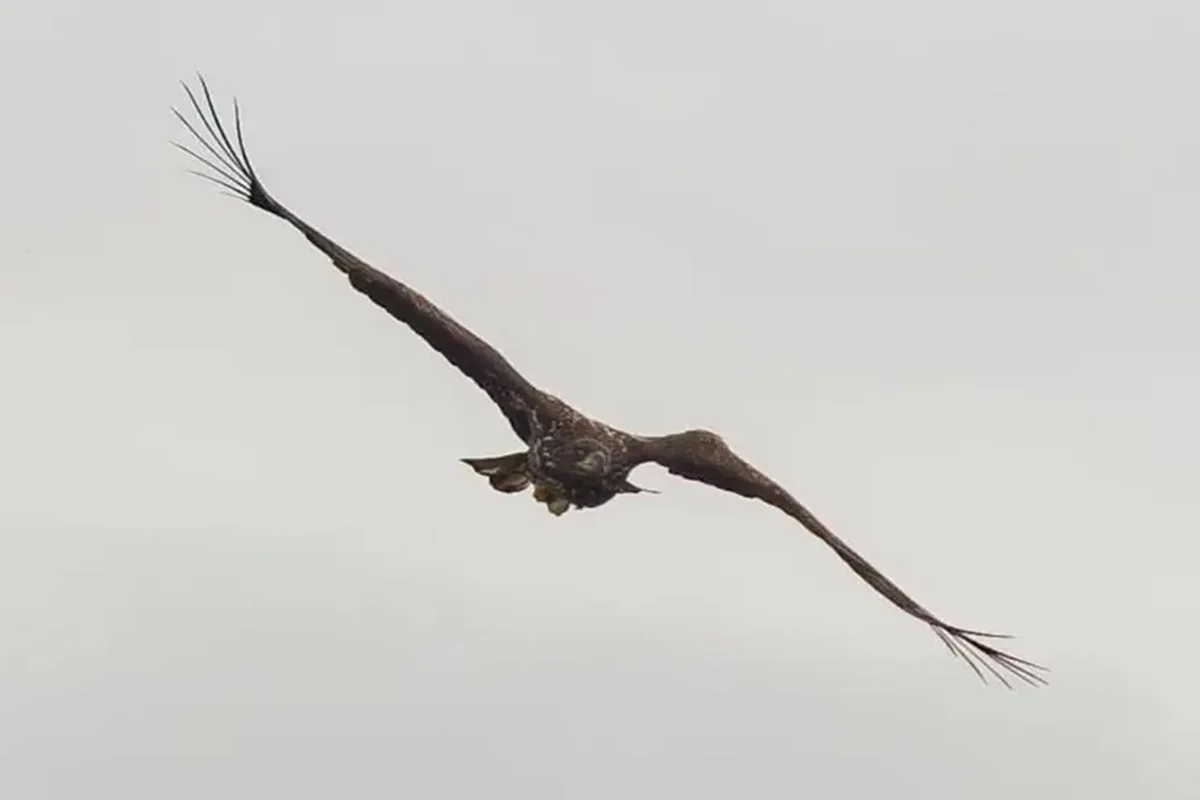
Kinky was not expected to survive after he broke his wing as a chick in 2023
A “death-defying” sea eagle that wildfire experts feared wouldn’t survive to adulthood has been spotted in the skies above Scotland’s west coast.
The white-tailed eagle, Kinky, fell from a nest as a chick in 2023 and suffered a break to his wing that left him with a distinctive wobbly flight. He received his name from a local skipper due to the kink in his wing.
Wildfire experts didn’t expect the bird to survive the injury, as young eagles naturally become independent by the winter of their first year and aren’t typically cared for by their parents after that.
But he was miraculously seen with his parents in August 2024 when RSPB ambassador Dave Sexton spotted the one-year-old chasing its father before being fed a fish.
The charity said it had never witnessed this behaviour before.
Kinky was spotted again in 2025 after a ship’s crew member saw him circling over the island of Eorsa in Loch na Keal, Mull.
Now, more than a year later, he has been seen again after naturalist and presenter Iolo Williams, who was working as a wildlife guide, spotted him.
He said: “I’d heard the incredible story of Kinky’s survival against the odds in 2023 and his parents still caring for him over a year later.
“So, to now see him alive and well, aged three and approaching maturity, is an absolute joy. Kinky is a truly inspirational eagle.”
Kinky is now three years old, but will not find a mate until he is around five, when the potential for conflict with other eagles increases.
Mr Sexton, who spotted the bird two years ago, said: “He had a death-defying start in life but things are about to get even tougher.
“As he nears maturity, looking for a mate and a territory of his own, he might clash with established pairs and that doesn’t always end well.
“But Kinky’s a born survivor; I’m keeping everything crossed for him,” he said, adding: “I’m in awe of this bird!”
The white-tailed eagle is the UK’s largest bird of prey and has a wingspan of up to 2.4m.
It was hunted to extinction during the early 20th century in England, with the species clinging on longer in Scotland until the last known bird was shot and killed in 1918.
According to the RSPB, the birds returned to Scotland in 1975 thanks to a reintroduction project it led along with Scottish Natural Heritage.
Join thought-provoking conversations, follow other Independent readers and see their replies