

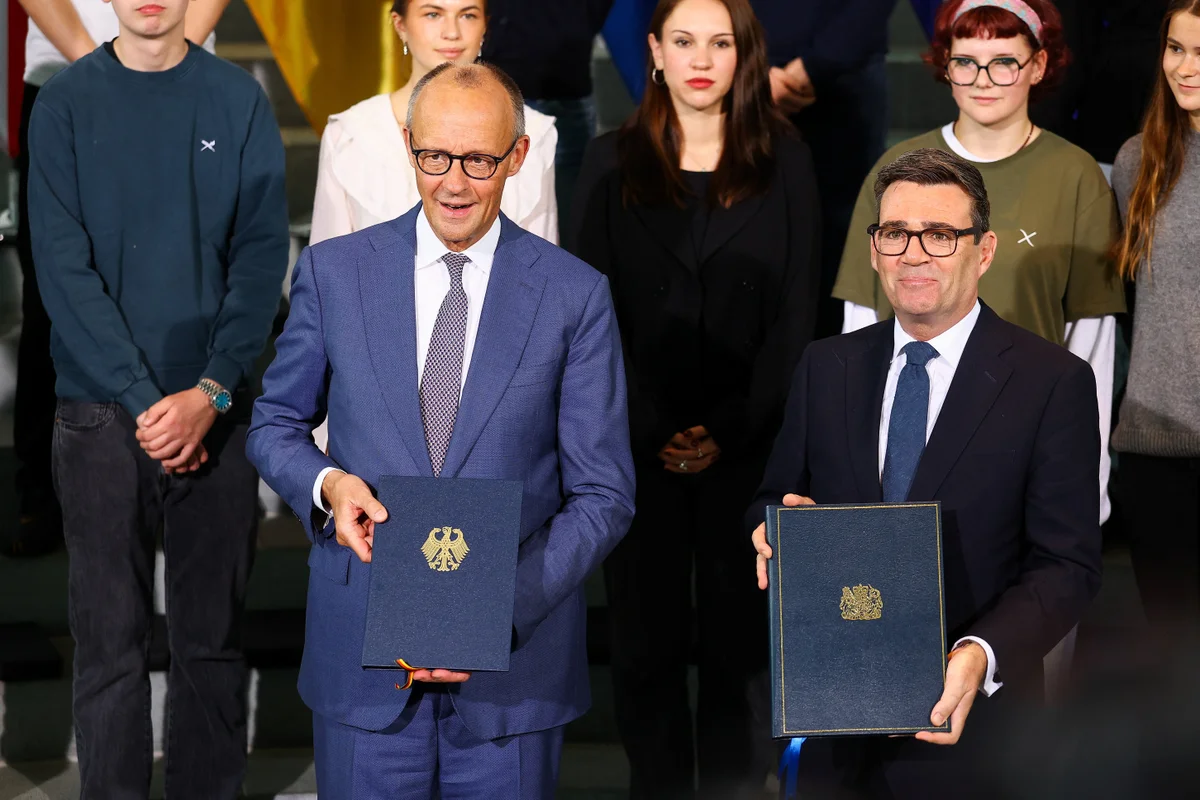
The two leaders are expected to confirm a joint UK-Germany security partnership
The prime minister has met Germany’s chancellor Friedrich Merz for the first time in Berlin for the launch of a new security partnership.
Andy Burnham arrived in the capital on Thursday morning where he was greeted at the Federal Chancellery with military honours ahead of his meeting with Mr Merz.
The two leaders are expected to confirm a joint UK-Germany security partnership to counter sabotage, cyber attacks and other hybrid threats from adversaries, especially Russia.
The partnership will involve sharing information and co-ordinating action to monitor, deter and disrupt threats and to develop resilience against threats to critical infrastructure.
Mr Burnham and Chancellor Merz are expected to discuss support for Ukraine, instability in the Middle East and the impact of disruption to global trade routes, such as in the Strait of Hormuz.
The two leaders will also convene a UK-Germany regional growth forum, bringing together British and German chief executives and focused on unlocking investment, strengthening industrial partnership and ensuring that the benefits of growth are felt in communities across both countries.
The Kensington Treaty, signed in July last year, will be formally ratified on Thursday, committing the two countries to deeper co-operation on science, technology, defence, security and growth.
Ahead of the visit, Mr Burnham said: “Attacks on our infrastructure, our businesses and our democracies are not a distant threat.
“They reach into people’s homes and workplaces, and they are designed to make us weaker and more divided.
“Britain and Germany are joining forces to find, expose and disrupt this activity.
“Security and growth go hand in hand, and both must be felt in every town and city in our two countries.”
The prime minister’s trip comes amid an intelligence scandal that has rocked Germany, with its former spy chief arrested on suspicion of espionage.
August Hanning, who headed Germany’s Federal Intelligence Service (BND) from 1998 to 2005, is “strongly suspected of treasonous espionage, spying out state secrets, attempted treason, and espionage”, the federal prosecutor’s office said in a statement.
Mr Hanning, 80, is accused of using classified intelligence to “draft an analysis” for an employee of one foreign intelligence service, and of “passing on information” to an employee of another foreign spying service.
A former aide, identified as Manfred D, was also arrested and has been charged with aiding and abetting attempted treason and treasonous espionage.
The prosecutor’s office said Manfred D worked as Mr Hanning’s chief of staff and later served as chief of staff for several subsequent BND presidents from 2012 until 2026.
Mr Burnham’s visit also comes at a time when concerns about sabotage and hybrid threats are on the rise in both the UK and Germany.
Last month, the British Government summoned a senior Russian diplomat to protest over an “egregious and reckless attack” at Germany’s Leipzig airport, a major international freight hub used for providing support to Ukraine.
A drone carrying explosives was found near Ukrainian cargo planes in August, but failed to explode and was subsequently defused.
Investigators suspect a second drone collided with a cargo aircraft nearby and a third drone was reportedly found near the airport 10 days later.
Germany’s interior minister, Alexander Dobrindt, said the Leipzig airport attack followed the “well-established pattern of Russian hybrid operations in Europe” and the assumption was that Germany would be targeted again.
Moscow denied involvement and Russian President Vladimir Putin accused Germany of planting evidence to blame Moscow.
Join thought-provoking conversations, follow other Independent readers and see their replies