

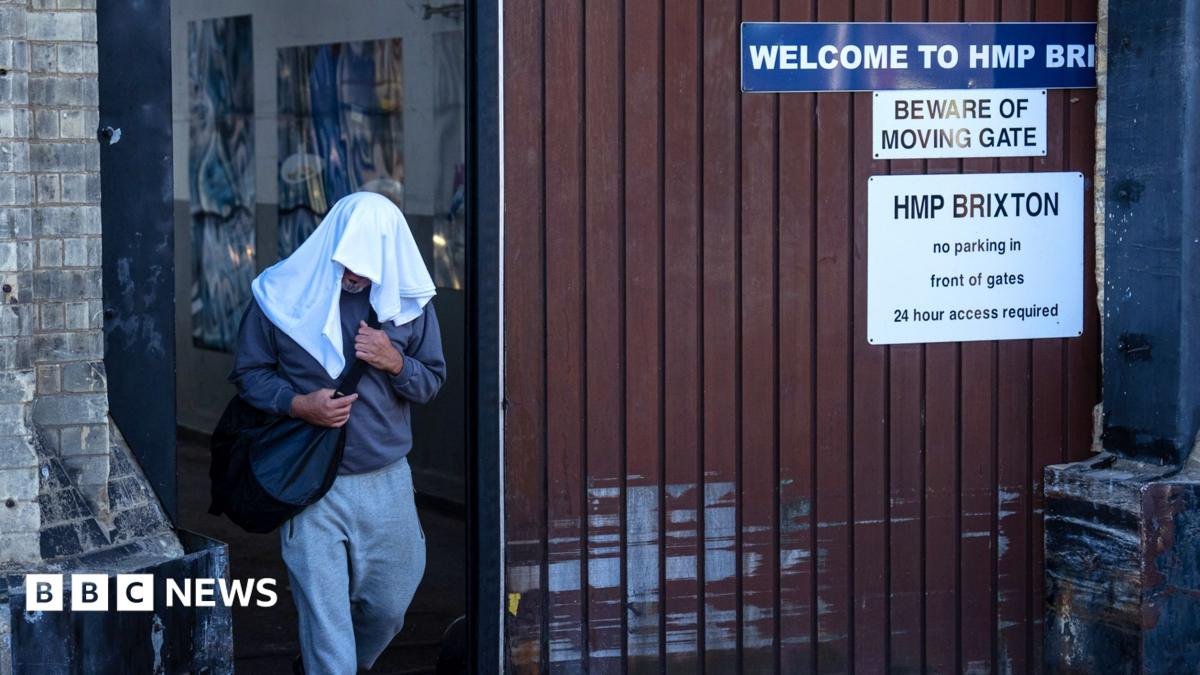
Home and Legal CorrespondentPublished13 October 2026, 02:13 BSTUpdated Just nowAbout 650 more offenders are leaving jails in England and Wales on Tuesday, in the second phase of the government’s plan to tackle the prison population crisis.
The group includes offenders serving up to two and a half years for crimes.
Under the new rules, they are leaving jail after serving a third of their sentence behind bars, rather than half.
The second wave of releases comes as the government takes its plan to radically overhaul criminal courts back to Parliament – but also as probation officers prepare to vote in a ballot that could lead to a strike over pay and workload.
Some 700 offenders left jail early on 1 October – all of whom were serving terms of less than 19 months.
Tuesday’s second stage begins the process of releasing batches of offenders serving increasingly long sentences – culminating next June with those serving more than 12 years.
Victims’ groups have raised fears about the early release scheme.
Alice Russell-Harris from the charity Refuge – which supports survivors of domestic abuse – told the BBC that domestic abuse perpetrators are among those being released.
This “will put survivors at serious risk of harm,” she said.
Even though they may walk out of prison with conditions such as electronic tagging and restriction zones, “we know that license conditions are frequently breached by perpetrators.”
Victims are worried that prisoners who walk free “will be able to continue their campaign of abuse once out of prison,” she said, adding that there are concerns about recent reports revealing that electronic tags are often not fitted on time for release.
Napo, the probation service union, said the releases have put enormous strain on its members, who are charged with monitoring the offenders in the community.
Typically, those being released should expect to be electronically tagged and subject to other monitoring conditions for the second third of their sentence.
On Tuesday, the union’s members will meet to discuss next week’s vote, which could lead to strike action. Probation officers have been offered a 5% pay rise by the Ministry of Justice (MoJ), while it had demanded 12% as part of a plan to make up for loss of earnings caused by cuts from 2010.
The MoJ says the offer is fair and has been accepted by two other unions and is twinned with a £700m investment in probation to recruit 1,300 extra officers and the roll-out of AI tools to cut the workload of monitoring offenders.
While the second phase of prison releases gets under way, the government is bringing its criminal court reform plan back before MPs, after announcing a week ago that it had abandoned the most controversial element of it.
The revised plan drops proposals for a new form of Crown Court where a judge alone, sitting without a jury of ordinary people, would reach a verdict against suspects facing up to three years in prison.
However, jury trials will still be scrapped for the most complex and long fraud cases – and another 5,500 trials will be kept in the lower magistrates court by ending a defendant’s right to ask for a jury trial.
The government says it will expand the use of so-called “blitz” or “short trial” courts after pilots have shown that grouping similar cases together can speed up their progression through the courts – cutting backlogs.
One of the pilots at the Old Bailey led to the London backlog of 500 cases concerning assaults on emergency workers being cut in half over the summer.
A major review of criminal courts by former appeal judge Sir Brian Leveson recommended more virtual hearings for defendants to slash wasted time bringing them to and from cells. The government has now ordered pilots for defendants to appear direct from police cells.
On Monday, the government announced it had accepted more than 150 of his 180 recommendations to modernise the criminal courts.
It has rejected his advice to retain a restriction on volunteer magistrates that means they can only jail an offender for 12 months. Under the government’s plan magistrates will have the power to jail for up to two years – the aim being to keep more cases out of Crown Court, to help clear backlogs.
Have you been affected by the issues in this story? Share your experience
How the new prison release scheme will work – and number of inmates to be freed
Hundreds of criminals start leaving prison under new early release scheme