

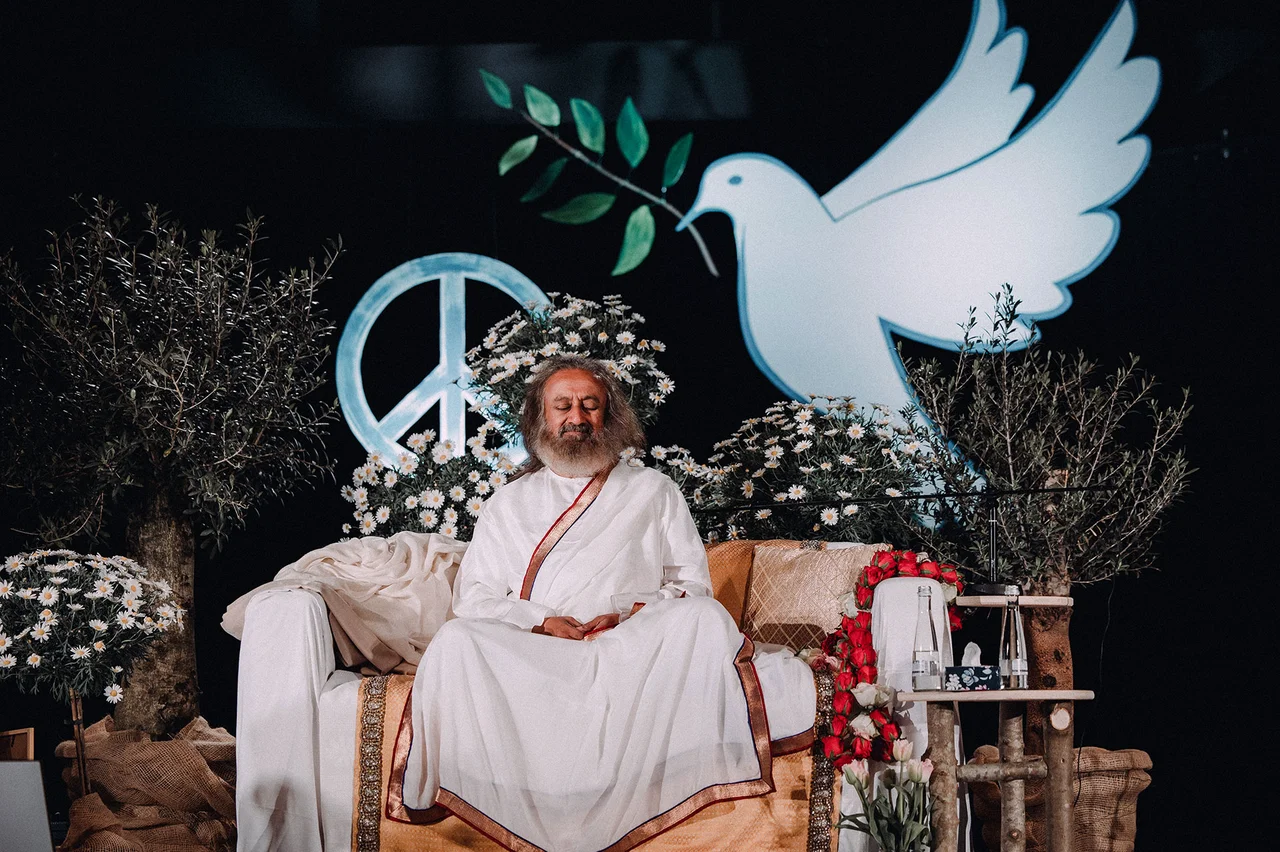
The Art of Living Foundation operates in European prisons, refugee facilities and post-conflict communities. Its founder just turned 70. The world showed up.
The European Union has declared a mental health crisis. One in six Europeans lives with a mental health condition. Waiting lists for psychological services stretch into years in France, Germany and the United Kingdom. Post-pandemic anxiety, the psychological toll of conflict on the continent’s eastern border and a measurable rise in social isolation have pushed the issue to the top of health policy agendas from Brussels to Helsinki.
Governments are spending more. The gap is not closing.
For 45 years, an Indian nonprofit has been working a different approach to the same problem — one that starts not with a prescription pad or a referral form, but with the human breath. This week, it celebrated its anniversary before 100,000 people in Bengaluru. India’s prime minister flew in to deliver the keynote.
Europe, it turns out, has been part of this story for longer than most people know.
What Kosovo Taught the World
Long before mental health reached the top of the EU policy agenda, the Art of Living Foundation was working in some of the most psychologically devastated communities on the European continent.
In Kosovo, in the aftermath of a war that killed more than 13,000 people and forced hundreds of thousands from their homes, the foundation deployed volunteers to run trauma relief programs inside refugee camps. The conditions were extreme. Conventional humanitarian frameworks — food, shelter, medical triage — were present in abundance. What they could not reach was the interior damage: the shame, the guilt, the numbness, the inability to sleep or feel safe.
Flora Brovina, then a parliamentary delegate and director of the Center for Mothers and Children, observed the foundation’s work firsthand. She noted that the breathing-based program reached women in the camps in ways that standard counseling had not. Kosovo’s Ministry of Health subsequently made a formal recommendation: mental health workers across the country should be trained in the foundation’s trauma relief methods.
It was not a marginal endorsement. It was a national health authority, in a post-war European state, certifying the efficacy of a technique developed by an Indian spiritual teacher.
Inside European Prisons
The foundation’s presence in European correctional systems is less documented but equally telling.
Its prison rehabilitation programs have reached more than 800,000 inmates worldwide, running in facilities across multiple continents including Europe. The core offering — breathwork, meditation and stress elimination — is designed for populations that conventional mental health services reach inconsistently, if at all.
One Belgian participant who completed the program offered an assessment that required no clinical framing to land: “The program has made me feel free from inside. And isn’t that a wonderful feeling for a prisoner?”
The foundation announced this week that its prison work will expand to 550 facilities across India alone, reaching an estimated 60,000 inmates and staff. The model being scaled in India is the same one already operating on European soil.
The Breathing Technique Western Researchers Are Studying
At the center of the foundation’s global programs is Sudarshan Kriya — a structured rhythmic breathing technique developed by the organization’s founder, Gurudev Sri Sri Ravi Shankar, who turned 70 this week.
The technique has moved steadily from the margins to the mainstream of Western clinical research. Studies examining its measurable effects on cortisol levels, anxiety markers and symptoms of post-traumatic stress have been published in peer-reviewed journals. Research institutions in Germany, the United Kingdom and across Europe have examined Sudarshan Kriya as a non-pharmacological, low-cost intervention — precisely the kind of scalable mental health tool that European health systems, under sustained financial pressure, are actively seeking.
The foundation has not positioned itself as a pharmaceutical alternative or lobbied for clinical recognition as a primary objective. The evidence has accumulated regardless.
A Syrian Boy, a Belgian Prisoner, a Kosovo Camp
The human geography of the foundation’s 45-year record reads, in many ways, like a map of Europe’s most persistent humanitarian failures.
Ibrahim was 12 years old when gunmen killed two of his brothers in front of him in Syria. He escaped. The memories did not. Every time he closed his eyes, they returned. It was not medication or conventional therapy that finally allowed him to sleep. It was ten minutes of guided breathing, taught by a foundation volunteer.
“These ten-minute meditations are worth a night’s sleep because I am finally able to rest,” he told his teacher.
That account is one of millions. In Iraq in 2008, Gurudev Sri Sri Ravi Shankar brought Shia, Sunni and Kurdish leaders into dialogue at a moment when such meetings were genuinely dangerous. In India’s northeast, a foundation-organized conference brought 67 militant groups — many holding opposing ideologies — onto a single platform to discuss reconciliation. One former militant said afterward: “My anger has turned into a smile. Earlier, it was difficult to imagine a normal life. Today, I’m leading a peaceful life.”
Rivers, Soil and 120,000 Children
The foundation’s environmental record carries direct relevance for European policymakers consumed by climate adaptation and agricultural resilience.
Since 2013, the Art of Living Foundation has led a water conservation program across India reaching more than 34.5 million people in 19,400 villages. It has constructed over 92,000 groundwater recharge structures, restored 59,000 square kilometers of degraded land and conserved an estimated 174 billion liters of water. An independent third-party assessment found groundwater levels in intervention areas were 20 percent higher than in comparable areas without the program.
The foundation has also worked with more than three million farmers to promote natural farming and reduce chemical dependence — an effort addressing both ecological degradation and the psychological toll of chronic agricultural debt. Its free school network, currently serving more than 120,000 children across more than 2,000 villages, is set to expand from 1,356 to 2,000 schools under initiatives announced this week.
Modi, Bengaluru and the Soft Power Signal
Indian Prime Minister Narendra Modi delivered the keynote at the 45th anniversary celebrations on Sunday, inaugurating the Dhyan Mandir — a newly constructed large-scale meditation hall at the foundation’s international headquarters — and launching nine nationwide service programs.
His remarks carried implications beyond domestic politics.
“I have always believed that society is more powerful than politics and even governments,” Modi said. “Any government can succeed only when society itself actively participates in nation-building.”
He described Gurudev Sri Sri Ravi Shankar as “a living embodiment of India’s timeless tradition of giving — giving knowledge, giving peace, giving hope.” In a personal remark to the founder, Modi told the crowd: “I am yours, and I am where I am because of you.”
Gurudev Sri Sri Ravi Shankar, addressing Modi in return, offered a line that landed with the weight of a diplomatic statement: “In less than ten years, you transformed India from a country that asked, into a country that gives.”
For European governments recalibrating their strategic relationships with a more assertive India — on trade, on technology, on the architecture of a post-unipolar world order — that framing is worth sitting with.
What 45 Years Produces
Gurudev Sri Sri Ravi Shankar has described his organization’s purpose in terms deliberately stripped of institutional complexity. “The Art of Living is more of a principle, a way of living life to its fullest,” he has said. “Its core value is to find peace within oneself and to unite people of all cultures, traditions, and nationalities.”
Europe is not short of organizations making similar claims. It is, however, short of organizations that can point to 45 years of documented results across refugee camps, prison wings, post-conflict communities, depleted aquifers and under-resourced classrooms — and a sitting head of government willing to fly across the country to say so in public.
The anniversary in Bengaluru this week was a milestone for an Indian organization. For Europe, paying attention, it was something else: evidence that the tools for the problems it cannot solve may have been quietly operational, on another continent, for longer than anyone was watching.