

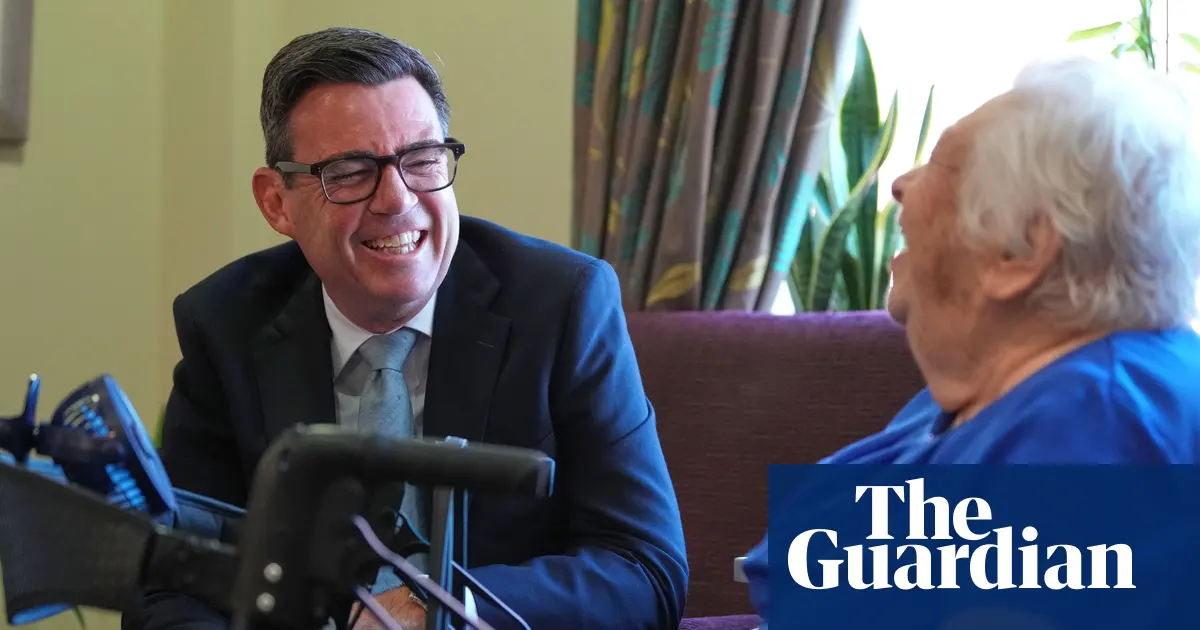
Andy Burnham has said the assisted dying debate needs to wait until palliative care and social care are fixed, as he delivered a speech to set out his path to resolving one of the most intractable problems in British politics.
The prime minister said he was not opposed to having the debate on assisted dying, but told reporters it would be “very challenging” to introduce the controversial legislation until the care system was in a better place.
Although as Greater Manchester mayor Burnham said he would probably vote in favour of a private member’s bill going through parliament, he said he now thought the priority should be to improve end-of-life support.
His caution may give some Labour MPs pause for thought when the latest version of the bill – which has divided backbenches across the usual party lines – comes before them for a vote in September.
“I take the view that that debate – and I don’t say that there shouldn’t be a debate at some point about those issues – personally, I think there’s something that needs to happen first,” he told reporters in response to questions.
“That is the fixing of the funding of palliative care and social care. I think it is very challenging to introduce that wider debate in a context of people not receiving that care and having the peace of mind about that care. That’s the way I kind of see this, and that’s the position that I will stick to.”
When Burnham was previously an MP, he abstained from a 2015 vote on another bill to legalise assisted dying because of concerns over safeguards and people feeling put under pressure.
But when the issue reared its head again in 2024, he said that his family experience in the nine years since – with his father, Roy, in a care home with dementia – had changed his view. “I think we do allow people to suffer and families to suffer too much,” he said.
At the time, he caveated his support as being for the principle of assisted dying, insisting he would want a requirement, before any new law was implemented, that hospices would be “properly funded and sorted out”.
The new prime minister’s remarks about assisted dying came during a major speech at a care home in north London about social care reform, an issue on which he has repeatedly said he was ready to expend his political capital.
Burnham indicated that his plan would probably require tax rises – though making the NHS and care system more integrated and therefore more efficient would help initially – and he repeated his promise to stick to Labour’s manifesto on tax for this parliament.
“I think more is possible from within existing resources. And the things that I’ve talked about today, particularly around the workforce, will be fully funded. I think it is possible from existing budgets to do much more,” he said.
“Some of what we would want to [do] in the fullest sense will require difficult decisions … But we will be honest with people about those. We will put them before the country at the right time, and we will hopefully proceed with people’s consent.”
However, Burnham said that life had “moved on” from when he last tried to achieve social care reform as health secretary under Gordon Brown in 2010 – when options had included a 10% levy on inheritances – suggesting that a “more voluntary approach” may work better now.
The prime minister has invited the Conservatives and Liberal Democrats for talks in Downing Street as he attempts to find common ground on the issue, saying he accepted that he may need to make some compromises.
“We are in a difficult world from a financial point of view. I can feel whatever I want to feel, but if I want to persuade others and get a cross-party consensus, you don’t just go in and say: ‘It’s got to be my way, and that’s it.’ Because how do you persuade people?” he said.
“I think there are ways of looking at this that could include a more voluntary approach initially, or could include a roadmap to a reformed social care system.”
Burnham added that “in an ideal world”, nobody would have to sell their home to pay for care, and that his 2010 proposals had been designed to address that, because if everybody contributed a little, most of what they had worked for would be protected.
“I think the whole thing is horrendous for those who live through it. They see everything that their parents have worked for just whittled away in front of them, paying for care that often isn’t good enough. The system isn’t right. And in an ideal world, no, I wouldn’t want to see that.”
Burnham said he would never forgive himself if he allowed “screaming headlines” in the media to deter him from trying to reform the system, after 22 failed attempts over the last three decades.
“On this issue, please can we have a factual debate? Can we allow people to weigh up the different options … and then just come to a considered view based on those facts?
“Is that too much to ask? I don’t think it should be too much to ask, because I think the public will give us their view. They’ll make it really clear what they feel they can accept and what they can’t.
“We won’t get to that point if there’s all of this stuff swirling around, and everyone frightened about everything. That just won’t get us there.”
He announced that Louise Casey would bring forward her independent review into social care options by a year, to summer 2027, and that the fair pay agreement for care staff would be the start of bringing the sector closer to NHS standards. Yvette Cooper, the new health secretary, will appoint a dementia tsar this summer.