

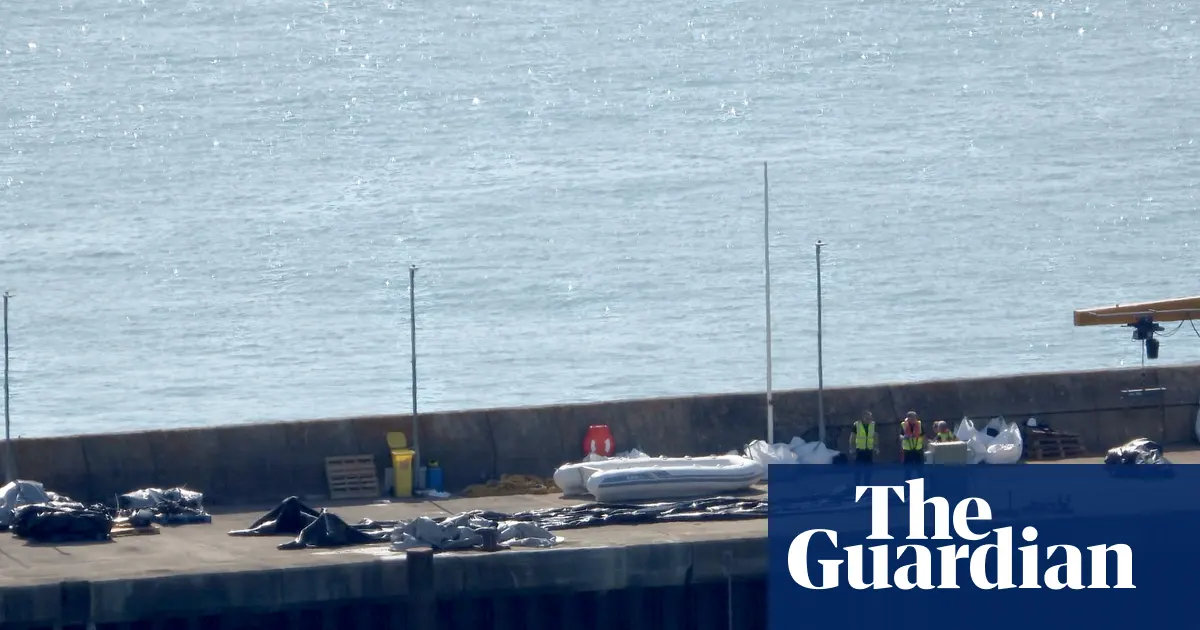
A dinghy carrying a record 230 people has arrived in the UK after crossing the Channel in the early hours of Monday.
It is the clearest indication yet that people smugglers in northern France are adapting their business model and escalating their so-called taxi boat strategy to evade enforcement by UK and French authorities.
The development is likely to be a blow to the prime minister and home secretary. Andy Burnham has vowed to be “relentless” and “bring back control”, while Shabana Mahmood has said the government is “bearing down” on small boat crossings.
French authorities told the Guardian that before an incident last week, in which a mega-dinghy carrying 173 people capsized after its engine caught fire, there had been nine mega-dinghy crossings of the Channel so far this year.
Although the number crossing the Channel this year has fallen by more than 40% compared with the same period last year, the increasing use of larger vessels demonstrates how quickly people smugglers have adapted to stronger enforcement by French police on beaches in northern France.
The UK government has struck a deal with Germany to increase seizures of traditional dinghies and engines “upstream”.
Last year, 106 people were reported to have crossed the Channel in a single dinghy in August and 125 in September. The emergence of mega-dinghies coincided with the announcement in July 2025 of the UK-France “one in, one out” deal, under which a person arriving in the UK from France by small boat can be returned in exchange for another person being brought legally to the UK to claim asylum.
On 12 July this year, a mega-dinghy carrying 128 people arrived in the UK, followed by another carrying 165 people on 23 July. On 4 August, a dinghy carrying 173 people capsized after the engine caught fire. All those on board are believed to have been rescued, with 11 sustaining minor injuries and three taken to hospital in Boulogne.
The use of mega-dinghies poses an even greater risk to life than smaller vessels, which have recently carried an average of between 50 and 60 passengers, according to NGOs working with asylum seekers crossing the Channel. When small-boat crossings began in 2018, only a handful of people typically travelled in each dinghy.
While there have been “green days” this year, when adverse weather has made conditions too dangerous for smugglers to launch dinghies, NGOs say many continue to wait in northern France for an opportunity to cross the Channel. They include some who have been returned to France under the one in, one out scheme and hope to reach the UK for a second time.
Hannah Marwood, the head of legal access at Care4Calais, which delivers emergency aid to refugees, said: “Deterrence doesn’t stop people seeking safety, it just pushes them towards greater danger and greater exploitation. We’ve worked with people who were returned to France only to face violence, exploitation and unsafe conditions, leaving them with no option but to risk another dangerous journey.
“Politicians keep promising that another tough policy will solve this but the evidence keeps proving them wrong. If the government is serious about stopping dangerous journeys, it needs to stop recycling failed gimmicks and create safe routes to claim asylum. When people have a safe way to reach protection, they don’t have to risk their lives to find it.”
A Home Office spokesperson said: “This latest incident demonstrates the reckless and dangerous tactics employed by the criminal gangs facilitating these crossings, who continue to put lives at risk by cramming ever greater numbers of people on to unseaworthy vessels. “We are making progress, with the number of small-boat crossings down this year and the lowest number recorded for the month of July since 2020. But we must go further, which is why we have signed a payment-by-results deal with the French to put 40% more boots on the ground on French beaches.”