

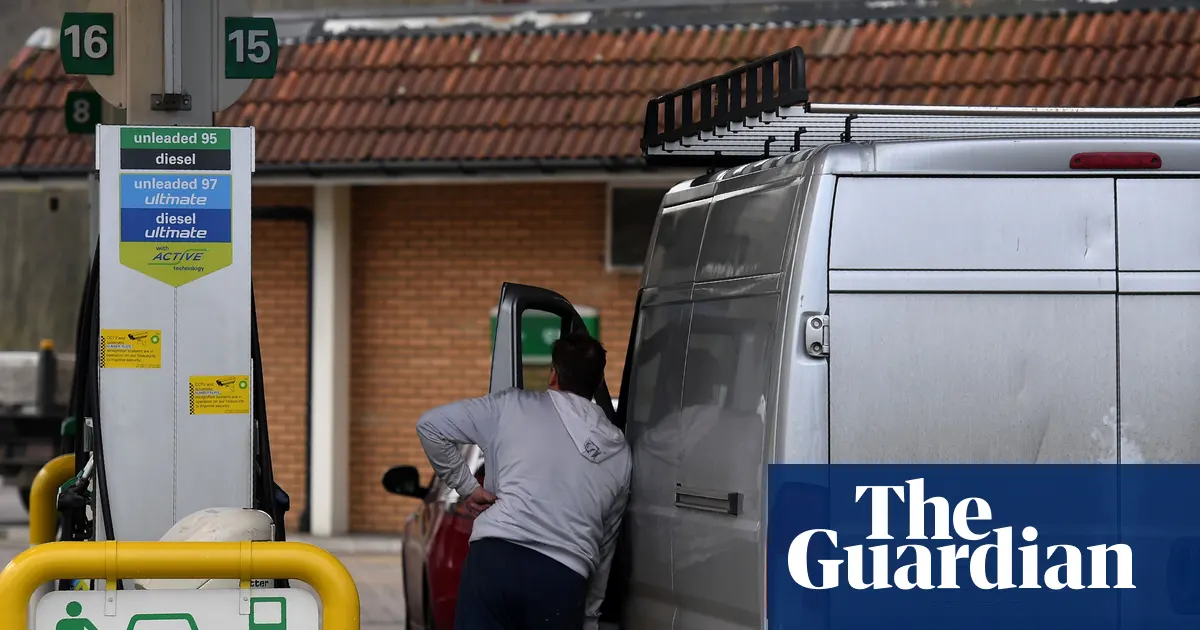
Millions of British van drivers face a combined £2.5bn cost to cover the rising price of diesel this year, according to figures, fuelling calls for the government to scrap its planned fuel duty rise.
The owners of diesel vans and pickups can expect to collectively spend almost £8.5bn at the pump this year, according to analysis for the Guardian, after diesel prices climbed to record highs due to a global fuel shortage caused by disruption to refineries in the Middle East and Russia.
The estimated fuel costs, calculated by analysts at Moneysupermarket, is significantly above the £5.95bn spent last year, raising concerns that the price of food and goods transported by road could rise sharply as retailers pass on increased logistics costs.
The comparison site warned last week that the average fuel bill for a van driver could reach £1,965 this year, up from £1,294 for the average van in 2025 based on typical mileage and fuel consumption.
The number of vans on British roads has grown significantly in recent years fuelled by the boom in online shopping, home deliveries and the rising number of self-employed people working in trades.
Although the adoption of electric vans has begun to increase, about 95% of light commercial vehicles are still powered by diesel. The average pump price climbed to a above £2 a litre for the first time this month, up over 40% since late February, when the US-Israel war on Iran began disrupting supplies of crude and refined oil products from the Gulf, leading to cost increases across the economy.
The rising cost burden has led to calls for government help in the upcoming budget, including abandoning plans to raise fuel duty from next year. The planned increase – postponed from September – will add 3p a litre in duty from 1 January, and another 2p from 1 March, in “a hammer blow” for costs, according to the Road Haulage Association (RHA).
Richard Smith, the RHA’s managing director, said: “Many of our members run on margins of around 2%. Surging diesel prices are impacting firms across the country, with some spending many thousands extra every week on fuel.
“Adding [fuel duty rises] on top of today’s fuel prices would be a hammer blow for many firms that move goods and the households that buy them. A fuel duty hike is a food price hike.”
Data from the motoring group RAC showed that, despite a recent dip in the cost of diesel, the price remains about 57p a litre higher than before the US-Iran conflict while petrol remains 42p higher. This means households are paying £31 and £23 more respectively every time they fill up a family sized car, according to the group.
The fuel duty rise “will only make prices at the pump even more expensive,” according to Simon Williams, the head of policy at the RAC.
“As things stand, this year is still set to be the second most expensive year on record for drivers,” Williams said. “The government has the power to take some of the sting out of higher fuel costs, either by extending and increasing the fuel duty cut or reducing VAT as they’ve done with domestic electricity.”
Smith added that the RHA was calling on the chancellor to bring in a 15p a litre rebate for British van, coach and haulage operators after Spain, France and Italy offered similar help for commercial vehicle businesses. “It’s time we caught up,” he said.
On Friday, the US president, Donald Trump, attempted to ease pressure at the pump for US drivers by announcing a deal for Russian deal, in a move which infuriated the Ukrainian president, Volodymyr Zelenskyy.