

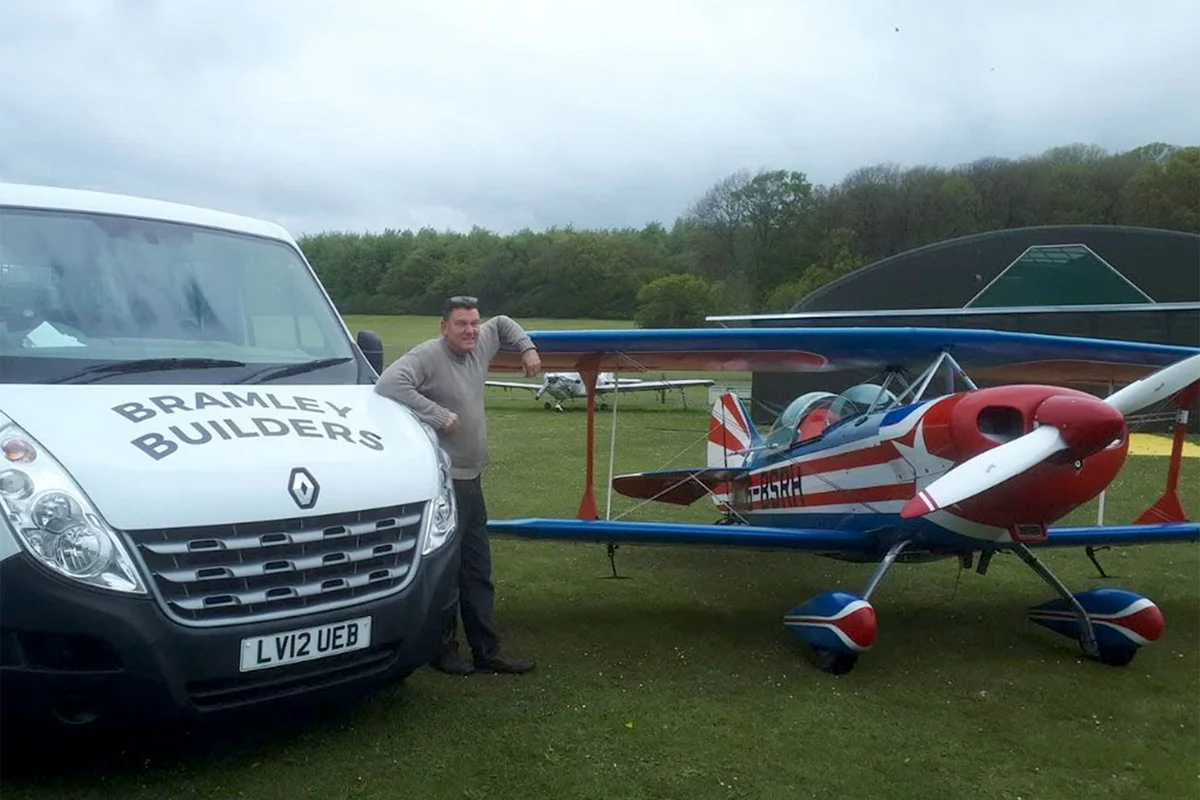
Trevor Davis claims that a crucial nut connected to the tail elevator was either missing or inadequately secured
A builder who nose-dived into a runway in an aerobatics stunt biplane is suing for £2m, blaming a “dodgy nut” for the disastrous crash.
Builder and amateur stunt pilot Trevor Davis, who cracked his skull and suffered multiple other injuries when he crashed 15 minutes after take-off at Popham airfield in Hampshire in March 2022, says a mechanical issue caused by a loose or missing nut left him unable to steer his plane properly.
Mr Davis, 64, who had previously taken part in aerobatics displays in the UK, is now fighting for up to £2m compensation for the effects of the accident – suing the Light Aircraft Association (LAA) who he claims should never have authorised his plane as safe to fly.
But lawyers for the LAA deny that the vital nut could possibly have been loose or missing during their inspection and are also criticising Mr Davis’ piloting skills, blaming him for the accident.
In documents filed with London’s High Court, the builder’s lawyers explain that Mr Davis’ Pitts Special biplane – a legendary aerobatic aircraft first designed in the 1940’s – had been fundamentally “rebuilt” for him shortly before the crash.
The Pitts Special is a “legendary” bi-wing stunt plane, which dominated stunt flying after its introduction in the United States in the 1960’s, and is renowned for its excellent manoeuvrability, although with a reputation for being tricky to land.
Mr Davis claims that a crucial nut connected to the tail elevator – which plays a key part in guiding the plane’s nose up or down – was either missing or inadequately secured after the build was complete.
The aircraft was inspected and signed off as safe to fly by an LAA inspector before he took to the skies in it, but after 15 minutes of flying Mr Davis says he found himself unable to control the elevator with his joystick, which he now blames on the elevator rod having come loose due to the dodgy nut.
The 1966-made stunt plane was bought in 2011 by Mr Davis, who in 2018 commissioned an engineer to “rebuild and modify” it in a three-year project, including stripping the original wings, disconnecting all flight control mechanisms and overhauling the fuselage.
He now claims expert evidence demonstrates that the connection between the tail elevator and the pilot’s joystick failed due to a nut from the elevator being loose or absent.
The LAA failed to raise a “red flag” over the plane’s fitness to fly, his lawyers say.
But lawyers for the LAA insist that there were no obvious shortcomings in the work carried out on the plane by the project engineer – or the report he submitted to the LAA.
The LAA insists that one of the team of engineers who rebuilt and checked over the Pitts Special “would have detected the absence of the nut/split pin had it been absent during the inspection,” adding: “It is further averred that the nut and split pin were indeed in position at that time of the inspections.”
The LAA also claims Mr Davis was partly to blame for the crash due to the way he handled his stunt plane as he came in to land.
Their lawyers state in the defence to the action that Mr Davis could have countered the nose dropping and prevented the nose-dive crash by increasing throttle to “give a burst of engine power”.
“He could also have chosen a far less challenging airfield to land at in the vicinity, for example, Thruxton,” argued defence barrister Christopher Loxton.
For his part, Mr Davis says he fought desperately to regain control using aircraft instruments such as the rudder and wing ailerons as he came in to land, but “despite his best efforts” the stunt plane ended up nose-planting into the runway before flipping over.
In the impact, he struck his head on the cockpit rim, resulting in brain damage and a fractured skull, alongside smashed teeth and injuries to his neck, arm and shoulder.
Mr Davis’ KC, Patrick Vincent, says that “he continues to suffer from headaches and cognitive and behavioural problems as a result of the head injury.
“He continues to suffer from right upper limb symptoms as a result of nerve damage – for which he requires surgery.
“As a result of the accident, Mr Davis has been unable to continue his work as a self-employed builder.”
Mr Davis’ case recently reached London’s High Court for a brief pre-trial hearing during which lawyers hammered out issues relating to the shape of the evidence and costs budgets.
It will return at a later date unless settled out of court.