

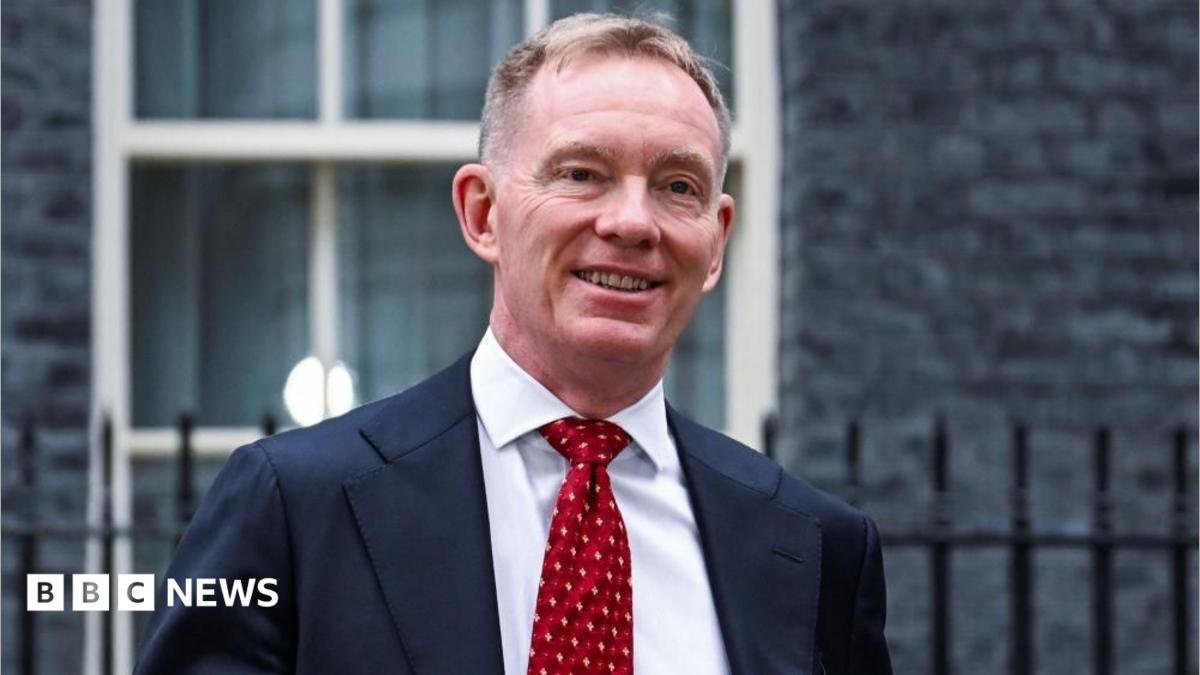
Some families of people killed during the Troubles have hit back at comments by the Northern Ireland secretary that he was worried “some people have misunderstood the purpose” of the Troubles legacy bill.
Sir Chris Bryant insisted it is “full steam ahead” for the government when it comes to passing Troubles’ legacy legislation through Parliament, during a visit to Dublin on Monday.
He said the bill was “about getting answers for families”.
Claire Hayes, whose brother Alan Radford, was killed in the Omagh bombing, said the comments from Sir Chris were “vague” and Kate Nash, whose brother William was shot dead on Bloody Sunday in Londonderry, said there was no misunderstanding.
Sir Chris Bryant comes to NI ‘with checklist not chequebook’
Published31 July’Progress made’ on bid to agree Stormont budget at castle talks
Published2 JulyNew legislation on Troubles legacy deal introduced in Westminster
Published14 October 2025The government has faced criticism for delays in passing the Troubles legacy bill, which was introduced last year, following agreement on a joint framework with the Irish government.
Labour’s bill seeks to replace the contentious Legacy Act, which introduced a ban on inquests and civil actions related to Troubles-era incidents.
Speaking on Monday, Sir Chris said the government would be tabling amendments to the legislation in the “next few days”.
He said the government had to “make sure we get answers for families” who had spent decades living with “pain and anguish”.
“We’ve got to step up to the plate, the Irish government has got to step up to the plate and we need to do that in lockstep,” he added.
Claire Hayes’ brother Alan Radford was just 16 years old when he was killed in the Omagh bombing.
Twenty-nine people, including a woman who was pregnant with twins, were murdered in the Real IRA attack on 15 August 1998.
Hayes said on BBC Radio Ulster’s Good Morning Ulster on Tuesday that the response from Sir Chris was “quite vague for anybody to be able to grasp”.
She added that he was being “very optimistic in the fact that he is going to rely on the Irish government to work lockstep with the British government”.
“That is never going to happen for a start,” she said.
“He is putting so much emphasis that they are going to do that, I can categorically tell you now that will never happen.
“There has been no justice and that is where we need to put the focus on, the fact that there was a failing of justice in all of these cases, the majority of them to see the least, it should have started in the courts with criminal convictions to start off with.”
Kate Nash’s 19-year-old brother William, was shot dead on Bloody Sunday.
Her father, Alexander, was seriously injured.
Thirteen people were shot dead and at least 15 others were injured when members of the Army’s Parachute Regiment opened fire on civil rights demonstrators in the Bogside – a predominantly Catholic part of the city – on Sunday 30 January 1972.
Nash said: “I think we don’t misunderstand at all, I think in my own case after 54 years of misunderstanding we do understand exactly.
“There has always been immunity there for soldiers, and the like and they have always had that protection even on the Saville Inquiry.
“They have had 54 years to get this right and they haven’t still, what they need to do is use the justice system honestly that’s what they failed to do.”
The new plan involves a Legacy Commission to investigate Troubles-related killings, a separate information recovery body, and a dedicated legacy unit within An Garda Síochána (Irish police).
A package of protections for veterans has also been proposed by the UK government.
But some MPs, including Northern Ireland MPs, have said the measures do not go far enough and want to amend the bill to include stronger protections in law.
Sir Chris told Irish broadcaster RTÉ that he worried that “some people have misunderstood the purpose of the bill”, adding that it was all about getting answers for families.
He said that would only happen if there is “transparency” from both Westminster and the Irish government.
On Tuesday, Sinn Féin MP John Finucane, whose father Pat Finucane was shot at his home in north Belfast by loyalist paramilitaries in 1989, said it “is clear that isn’t a problem of families misunderstanding the legislation, the concerns that they have are real, they are substantive”.
“The answer isn’t to explain the legislation better, it is to make the legislation better,” he added.
“Legacy is far too important to get wrong again and the objective isn’t simply to get legislation on to the statute books, the objective has to be to get it right for families who have already waited far too long for truth and justice.”
Finucane said that “essential to all of this has to be equality before the law, so nobody, absolutely nobody, including British state veterans should receive preferential treatment because of who they are, or who they served with”.
Democratic Unionist Party (DUP) assembly member Phillip Brett’s brother Gavin was murdered by loyalist paramilitaries in Glengormley, County Antrim, in July 2001.
He said it is “clear there are concerns right across the board with the proposals from the Labour government in relation to this legislation”.
“I think it is important to recognise that at the core of legislation we need something that deals with the need for victims and survivors because they have witnessed for years legacy here in Northern Ireland be corrupted, be that through the Belfast Agreement with the release of terrorists or be that through the royal prerogative of mercy given to people after the Belfast Agreement.”
“We are determined to deliver legislation that ensures that all people in Northern Ireland, all victims in Northern Ireland are able to get truth and justice,” he added.