

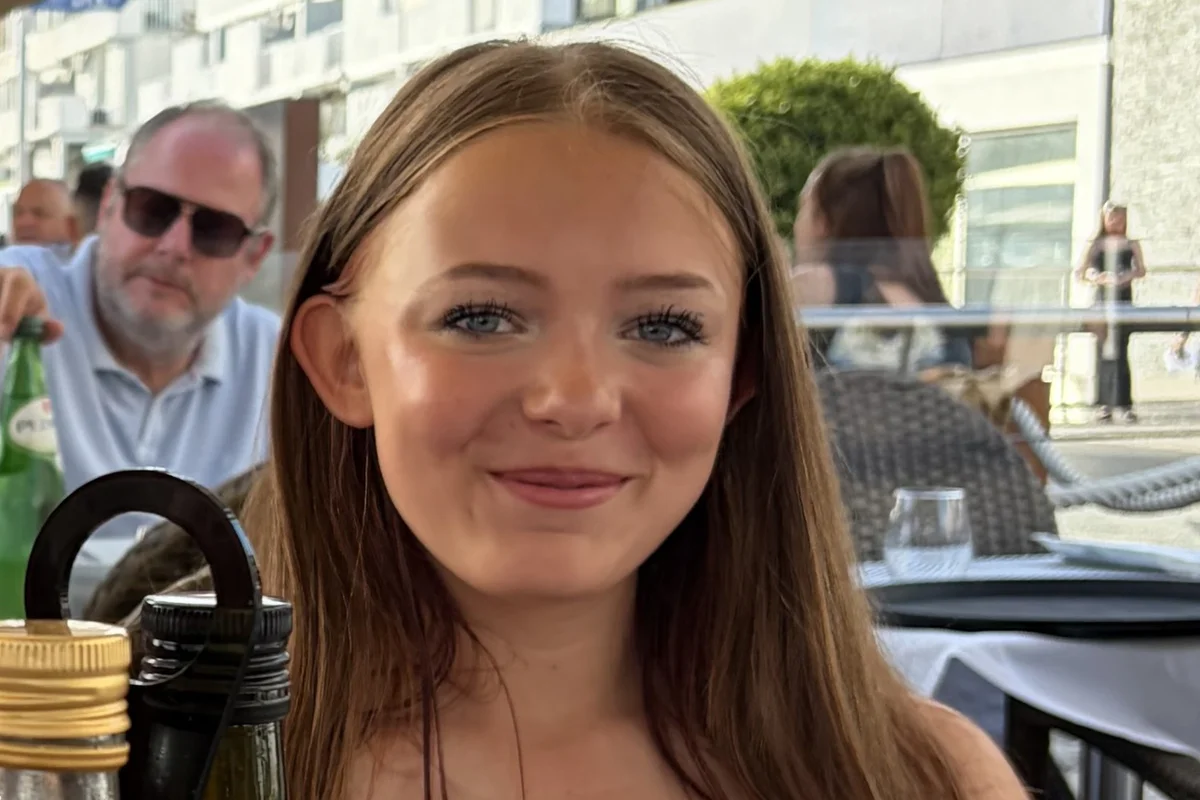
Lillie Yale received the device, known as Memosorb, to treat an atrial septal defect: a hole in the wall that divides the two upper chambers of the heart
A teenage girl has become the first UK patient to receive a dissolvable implant designed to close a hole in her heart roughly the size of a 10 pence piece.
Lillie Yale, a 14-year-old from Warrington, had previously faced the prospect of a permanent metal device, which could have disrupted her dream of becoming a professional rugby player.
Instead, the biodegradable device will serve as a scaffold, allowing Lillie’s heart to repair itself over coming months and years before fully dissolving and leaving no trace behind.
The operation was carried out in June by surgical experts at Alder Hey Children’s NHS Foundation Trust in Liverpool.
The hospital secured a special licence from the medicines regulator to use Memosorb on Lillie.
It represents the first UK use of the Memosorb device on a patient diagnosed with an atrial septal defect (ASD), which is an abnormality defined by a hole in the wall separating the heart’s two upper chambers.
Lillie’s mother Becci Nichols, 38, said her daughter is “healing perfectly” and has since ran a 5k, visited a theme park and has returned to playing rugby.
Memosorb is made of biomedical polymers, commonly used in dissolvable stitches.
Dr Salim Jivanji, consultant paediatric cardiologist at Alder Hey, told the Press Association: “The device looks very similar to a normal existing device that we have on the market.
“The difference being that it’s made out of a polymer.”
He said with a traditional metal device, tissue would start lining the implant, while Memosorb acts as a “scaffold”.
“The body reacts with the structure of the device,” Dr Jivanji told PA.
“It slowly covers it with the lining of the heart, and the polymer starts getting dissolved into carbon dioxide and water within the tissue and slowly disappears completely.
“I would say in anywhere between six to 24 months the only thing you’ll see is what looks like the a normal septum with no hole in it.”
According to Dr Jivanji, Lillie would not have been able to play rugby if she had a metal implant, as there is a risk it could be dislodged by heavy impact before her heart was fully healed.
There is also a risk of mechanical stress to a metal device in the heart.
However, he said his patient was “determined” to continue with the sport.
She said: “I’m really happy it’s all done now, and it’s amazing to know I was the first person in the UK to have this new type of implant.
“I’m enjoying doing the things I love and not having to worry about my heart.”
Lillie is now having check ups every couple of months to monitor her progress.
Ms Nichols said: “She is healing absolutely perfectly. She’s been doing loads.
“She’s back in her rugby full swing, and she did the Pretty Muddy 5k. She’s been off to Alton Towers, and she’s just getting on with everything now.”
Ms Nichols was told that Lillie had ASD soon after she was born prematurely at 33 weeks.
ASD affects roughly one to two in every 1,000 babies, and can sometimes be detected in adults as smaller holes cause fewer symptoms.
Lillie had regular check ups and no symptoms until January 2025, when tests revealed her heart had become enlarged on the right side.
Ms Nichols said she was not too worried, as her own mother had discovered she had ASD when she was in her 40s.
“I knew what it meant when it said that her heart was enlarged, and I knew how serious it can be,” Ms Nicholls told PA.
“But it was only slightly enlarged, so I didn’t worry too much. But I knew it needed rectifying.”
Doctors initially said they would fit Lillie with an implant within two years, but her mother pushed for it to be sooner so the operation did not interrupt her GCSEs.
It was only then Lillie was told she would not be able to continue with her sport if she had a traditional metal device put in her heart.
Ms Nichols said Dr Jivanji and his team “went above and beyond” to allow Lillie to “continue with her normal life”.
“Sometimes you can leave an appointment feeling like someone is simply doing their job, but every member of the interventional cardiology team and nurses on ward 1C who cared for Lillie made us feel that they genuinely wanted the very best for her and for our family,” she said.
“Their kindness, compassion and dedication made an enormous difference to us throughout our journey.”
Dr Javanji also hailed the “team effort” from his colleagues at Alder Hey.
He said: “We constantly do really state-of-the-art kind of cases, but these cases require so much discussion, so much understanding…we advance innovation all the time, and it requires a real big team effort.”
Join thought-provoking conversations, follow other Independent readers and see their replies