

The objective of female covert surveillance officers was to disappear into the background. Liz* tells Sam Kiley how that required obsessive attention to detail: no Army-issue watch, no perfume, no brightly coloured clothes – and no false steps
They never spoke of what they did. Their quiet but heroic acts of bravery, their pioneering role as women of the special forces remains largely unacknowledged – yet they formed the backbone of the most secretive military intelligence organisation since the Second World War.
Shut out of both the Special Air Service and Special Boat Service, banned from serving on the front lines, the women of 14 Intelligence Company walked the streets of Belfast and carried out surveillance from unmarked cars to build enough intelligence to take down paramilitary groups.
One of the most important parts of the tapestry of counter insurgency work that evolved in Northern Ireland during the so-called Troubles, they were often recruited in a manner of the Old Boys’ Network with a “tap on the shoulder”.
But they were women, and often very young, for the most dangerous of jobs.
Now, for the first time, “Liz” is prepared to tell part of her story in SAS: The Shadow War.
Listen to the full fourth episode of SAS: The Shadow War here, or become an Independent Member for exclusive access to all eight episodes:
Initially working alone, she also trained others – men and women – to walk the streets of the republican heartlands following IRA and INLA suspects, helping to identify gunmen and bombers.
Often, she was only a few feet from men who would have killed her if they discovered who she was.
Nearly half a century later, sitting safely in a studio, Liz still finds it difficult to tell a stranger anything. She deflects questions. She qualifies answers. Names stop on her lips.
Liz had been trained to become “grey”: unnoticed, unremembered. She had been trained to resist interrogation, to keep every detail of her life “across the water” secret – failure could be fatal.
It took two in-depth interviews to get glimmers of her past life.
What emerges is a remarkable portrait of 14 Intelligence Company. Known inside the security forces world simply as the Det — short for Detachment — the covert surveillance organisation developed during the Troubles, becoming the main ancestor of today’s Special Reconnaissance Regiment.
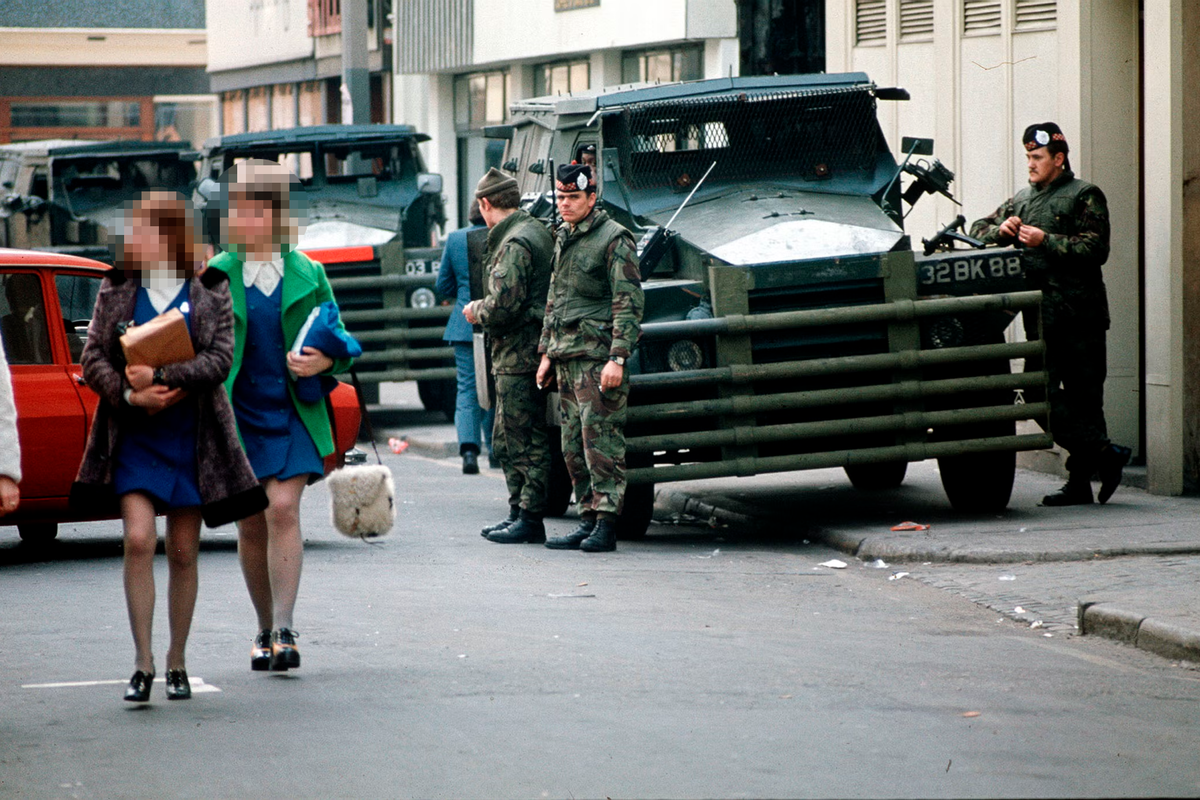
The British Army had entered Northern Ireland in 1969 wearing uniforms, travelling in armoured vehicles and occupying fortified bases. But against clandestine organisations whose members lived apparently ordinary lives among the population, conventional military power had severe limitations.
“You’ve got an intelligence vacuum,” says Bob*, another former 14 Intelligence Company operator.
Starting with a known person, house, workplace or vehicle, Det operators would follow threads through the civilian population: A meets B; B visits C; C drives to another address.
Slowly, hundreds of apparently insignificant observations could become an intelligence picture of a bombing team, weapons network or command structure.
Liz joined the Army at 17 and was serving in Northern Ireland as a young intelligence clerk when an officer approached her and asked a simple question:
That was more or less her recruitment interview.
She was 19 when she entered the Det’s world.
In covert surveillance, however, being female was not a disadvantage. It could be a huge operational asset.
Two military-looking men sitting in a parked car attracted attention. A man and woman could be a couple. A young woman could walk through streets while a military-age male loitering alone might immediately be noticed.
The objective was to disappear into the background. That required obsessive attention to trivia.
No Army-issue watch. No perfume. Nothing brightly coloured. Nothing about a car’s number plate, age or interior that might look wrong. No glimpse of a radio or concealed weapon.
Liz sometimes wore the sort of housecoat used by female factory or mill workers. Underneath it could be hidden her radio and a pistol. The housecoat was closed with Velcro so it could be opened easily if she needed her 9mm Browning.
She wasn’t trying to become part of West Belfast. She was trying to pass through it without leaving an impression.
“You were trying to be very grey,” she says. “Unmemorable.”
Liz spent months learning every street, alley, cul-de-sac and cut-through in Belfast before being considered fully useful.
“You couldn’t afford to make one mistake,” she says.
“Sadly,” she adds, “some of the small mistakes… ended up in people losing their lives.”
One of Liz’s fellow Det operators, Doug Oram, was killed after a covert position was compromised. She had trained alongside him and rehearsed ambush scenarios together.
Most of Liz’s first tour concentrated on weapons and explosives networks. “If you’re following the weapons,” she says, “then you’re following the badness.”
Her own closest calls demonstrate how microscopic the margin could be.
On one operation, Liz and a male colleague were providing cover for a covert reconnaissance operation involving explosives. They parked near the Shankill Road and moved away from their car, but had left weapons hidden inside it.
Unknown to them, they had parked outside the home of a senior loyalist figure. When they returned, her experienced partner noticed something. A tiny light inside the glove compartment was on.
The pair walked straight past their own vehicle, continued down the Shankill and called to be extracted from an area where they risked being seen as an IRA kill team.
Had she opened the car door and climbed back in, she says: “Without a shadow of a doubt… I’m sure that they would have killed us.”
Weapons moved between safe houses. Bomb makers met quartermasters. IRA and INLA units planned operations. Loyalist paramilitaries hunted their own enemies. Special Branch recruited informers. MI5 listened. The Army watched.
Listen to the first four instalments of SAS: The Shadow War now, or become an Independent Member for exclusive early access to the entire series. Available on Apple Podcasts and Spotify
Join thought-provoking conversations, follow other Independent readers and see their replies