

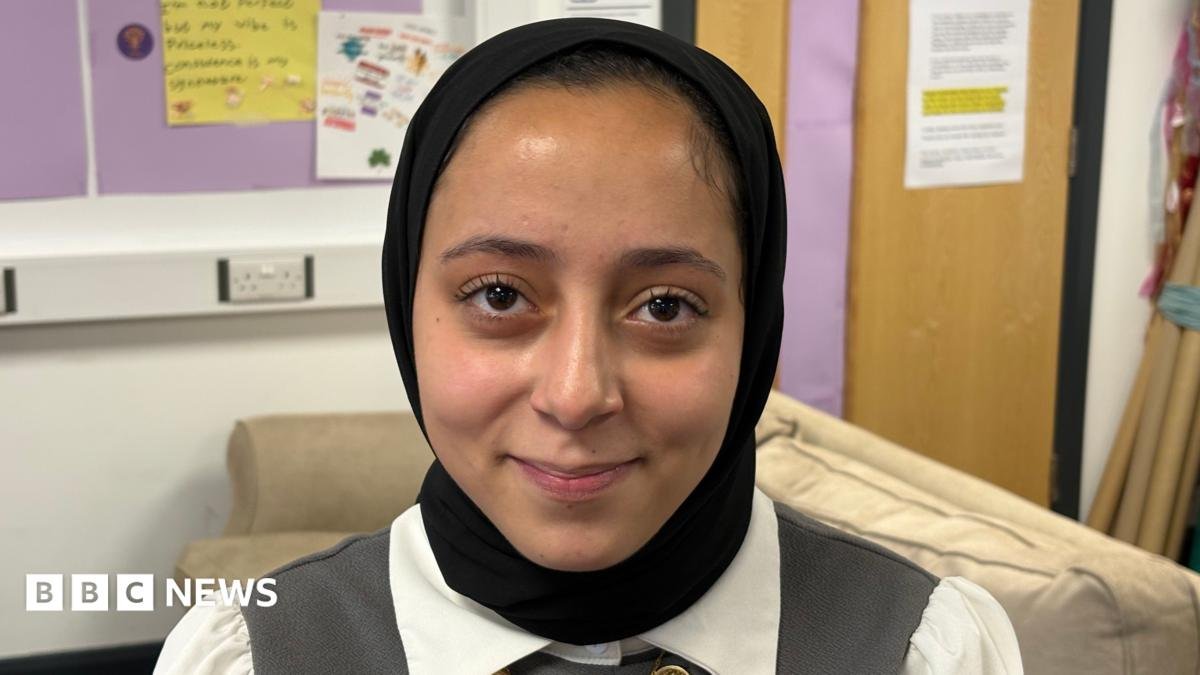
Education and arts correspondent, BBC News NIPublished2 hours agoIn war-torn Gaza, 16-year-old Mona was able to receive more education than she says she’s currently able to get in Northern Ireland.
That is because, as a refugee or asylum seeker aged 16, she is not automatically able to enter school or college in Northern Ireland.
At present, the legal age until which education is compulsory is 16.
But that can leave young people like Mona who have fled conflict to come to Northern Ireland, with no automatic right to education.
BBC News NI has asked the Department of Education and the Department for the Economy for comment.
Mona came to Northern Ireland from Gaza with her family, including her younger siblings.
“I came here to continue the education and be safe here,” she said.
“In Gaza I studied online, because of the war.”
When Mona arrived she was 15 and did not speak English, though she has learned English since.
She initially attended school in Coleraine, but since her family moved to Belfast she has not been able to get a place in school or college.
“I feel stressed because I cannot find anything for me,” she said.
“I would like to study nursing… Because I want to go back to Gaza and help the people in Gaza.
“We are still children and we need education and support.”
Sara, 19, who came to Northern Ireland from Sudan in 2024 faced similar frustration.
She received qualifications in Sudan, but although she wants to be a doctor she has been unable to get a university place to study medicine.
“When I came and I tried to get into university they said that as I am a refugee my qualifications would not suffice,” she said.
“I had to get the same qualifications as students in Northern Ireland which can be quite frustrating.”
Sara speaks very good English but had to wait a year to be admitted to Further Education (FE) College to study A-Levels.
Like Mona, Sara has received some help and support from Anaka Women’s Collective, a community organisation which provides support for asylum seekers.
Anaka has previously called for a specialist education programme for those aged 16-24 who come to Northern Ireland as asylum seekers and refugees.
Hani, 20, from Iraqi Kurdistan and 22-year-old Hossam from Sudan both previously contributed to a report called Stranded Dreams, which outlined the problems older teenagers who were asylum seekers could face when trying to access education.
Both want to set up their own businesses but both are frustrated that little has changed since the Stranded Dreams report was released over a year ago.
Hani has been living in Northern Ireland for four years, and as she was 16 at the time she came her younger siblings could start school but she could not.
Although she registered for English for Speakers of Other Languages (ESOL) classes she had to wait two years before a place was available.
That has delayed her being able to enter classes to take GCSE courses.
“Personally I would love to study a course in business and marketing,” she said.
“Young people that have arrived in this country need to have a fair opportunity as other young people in this country.
“Whenever me, my friends and young people come to this country we are starting from zero and we need a pathway to walk in.”
Hossam, who has been living in Northern Ireland for three years, feels the same.
“It’s surprising, it’s really hard to continue in education,” he said.
“I really want to be a businessman and fashion designer also.”
“So that’s my dream and it’s really hard to do it here.”
The Northern Ireland Executive published a Refugee Integration Strategy in 2025, external to help refugees and asylum seekers integrate into Northern Ireland.
While it aimed to help asylum seekers and refugees “to achieve their full potential” it did not include any specific commitments to provide better access to education for older teenagers.
Where do lone asylum seeking children end up?